First of all, lets be clear here…
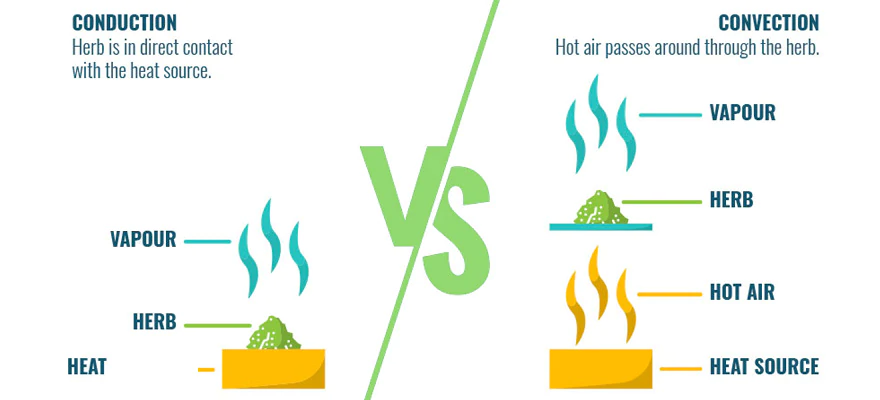
Conduction is the transfer of heat energy via direct contact.
(eg: flame to herb-chamber, herb-chamber to the botanicals themselves)
(“Respect the click!“)
Convection is the movement of heat by the motion of matter.
(eg: hot air passing through your botanicals)
Both methods of T.E.D. consumption are common.
Both methods are favoured for their own independent characteristics.
Conduction T.E.D. Pros
They heat up quickly.
They’re often very strait-forward to use.
Often powered by a butane lighter, there are no batteries or leads to annoy you.
Conduction T.E.D. Cons
It can be easy to combust if you don’t pay attention.
If you don’t focus then you could be prone to uneven heating.
Convection T.E.D. Pros
There’s little risk of combustion.
They will generally heat your botanicals more evenly with less focus required.
Multiple controlled and pre-set heat settings are often possible.
Flavour, flavour, flavour.
Convection T.E.D. Cons
They are often expensive.
They generally require batteries or a power-supply.
They take longer to heat up.
“How does the Vapcap work?”, you ask
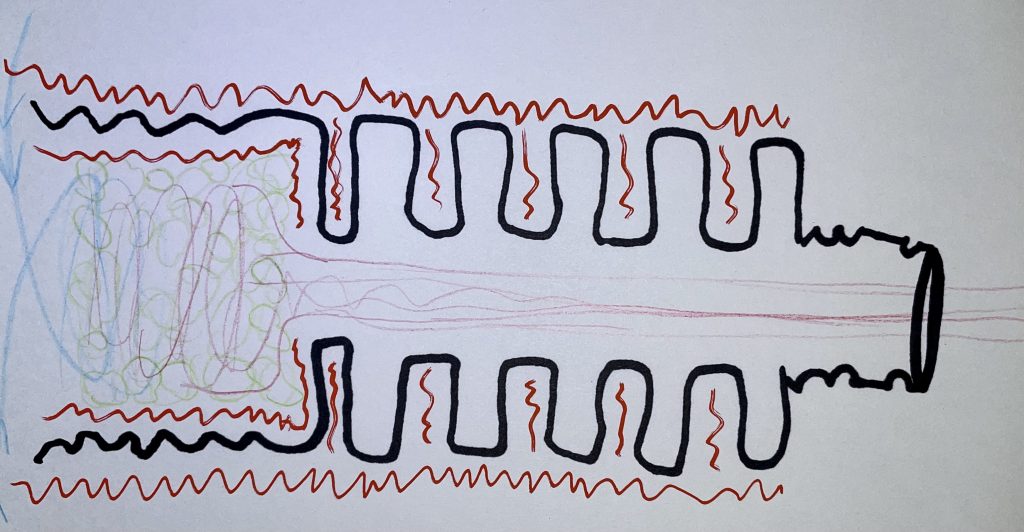
A Vapcap works using a combination of conduction, convection and of course radiant heat (energy transmitted by electromagnetic waves, like baking a potato in the oven, or you enjoying the sunshine).
A Vapcap’s heating process begins using conduction as you heat the Cap and Tip.
They in turn heat the botanicals in the herb-chamber (using conduction and radiation).
Then, as you begin to draw on the device the convection process kicks in and increase vapour production and quality as fresh air spirals up the outside of the Vapcap’s hot Tip, up and under the hot Cap and then passes down through your botanicals on it’s way to you.
Using various controlled methods, the air movement through a Vapcap when inhaling can significantly increase vapour production and is key to a full and flavoursome extraction.
This is achieved through experience.